
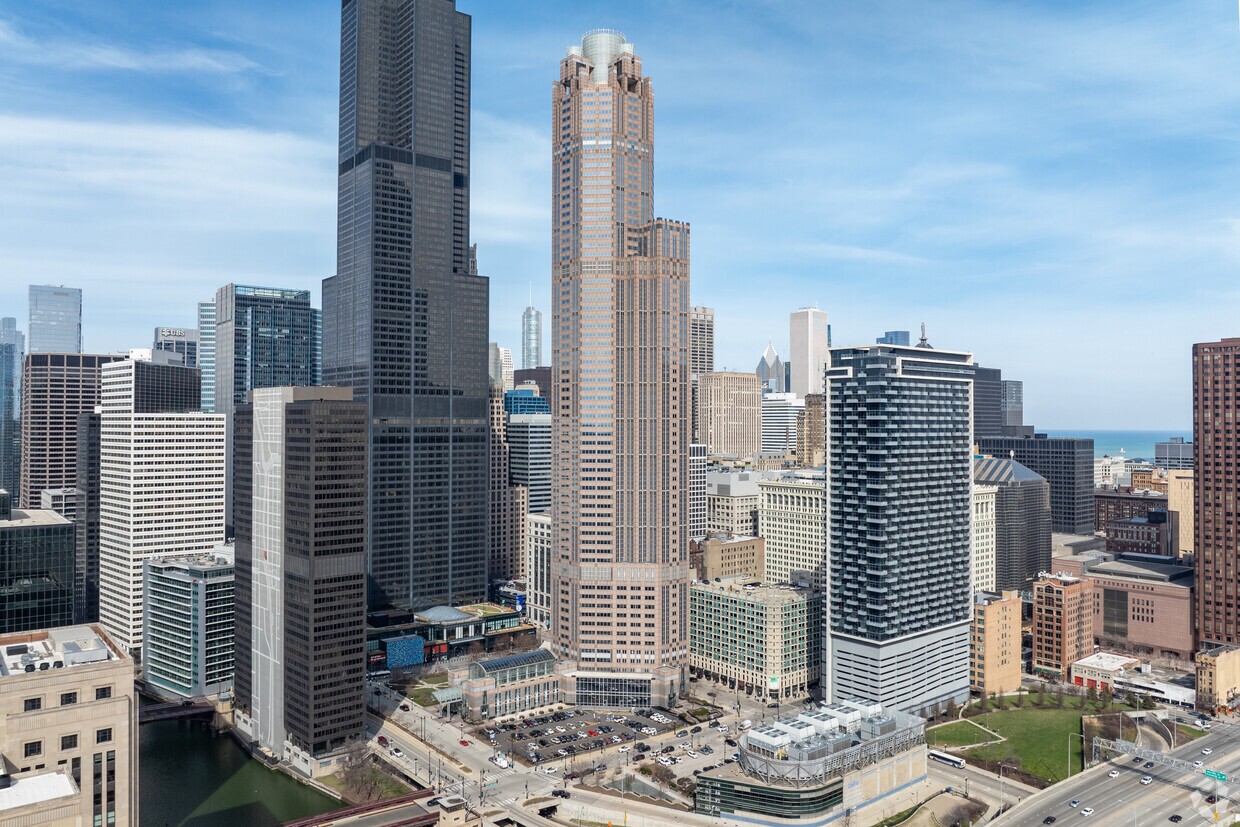

Chicago’s real estate community is abuzz in recent days after word emerged that one of the city’s tallest skyscrapers is set to sell for about $70 million, a steep discount from the last time it changed hands, although the object of their chatter is not primarily the sale price.
More tantalizing is the long-shot prospect that the sale of the 65-story office building could lead to the biggest voluntary demolition in world history, erasing a prominent part of the skyline.
Local investors John Murphy of Murphy Development Group and Gerald Kostelny of InSite Real Estate have a contract to buy the more than 1.3 million-square-foot tower at 311 S. Wacker Drive at a fraction of the more than $302 million it last sold for in 2014.
Those investors’ involvement is significant, because they already have been working in recent years with development behemoth Hines on potential ground-up projects for vacant sites on each side of the 961-foot-tall tower at 301 S. Wacker and 321 S. Wacker.
If Kostelny and Murphy secure equity and debt to complete the purchase of 311 S. Wacker amid challenging real estate conditions, it opens several possibilities for the future of the site alongside the 110-story Willis Tower, the city’s tallest skyscraper. The 1,451-foot-tall former Sears Tower is at 233 S. Wacker.
One scenario for 311 S. Wacker would be working with Houston-based Hines to tear down the tower.
If it were to come to that, demolition crews would eliminate a 35-year-old building that has underperformed in the Chicago leasing market while creating a full-block parcel that eventually could include multiple new skyscrapers with well over 4 million square feet of space combined.
Hines has long discussed buying the tower out of financial distress and demolishing it, according to people familiar with the situation.
Such talks are preliminary, and there are other options on the table. Yet the involvement of Hines and its development partners on adjacent sites, coupled with the unique real estate circumstances that have led to the highly discounted price, make the idea at least plausible.
“I’m not surprised they’re contemplating that,” said Shawn Ursini, senior manager of the Council on Tall Buildings and Urban Habitat’s Skyscraper Center database of high-rises throughout the world.
Similar plans are playing out all over the world including in North American cities such as Detroit, Toronto and Miami, he said.
“This is something we’re going to see a lot more of,” Ursini said. “If you’re concerned about sustainability, this is a potentially worrisome trend.”
Hines has not publicly discussed the preliminary plan, and the firm did not respond to requests for comment from CoStar News.
High degree of difficulty
Hines would need to clear massive hurdles before a wrecking ball becomes part of the firm’s ongoing joint venture to redevelop the overall site with Murphy and Kostelny, according to people familiar with the matter.
Demolition could cost tens of millions of dollars beyond the acquisition cost, potentially adding up to a total investment of $100 million or more just to clear the site and start over — at a time when developers already face steep hurdles.
If it were to happen, it would become the tallest building in world history to be voluntarily torn down, according to the Council on Tall Buildings and Urban Habitat.
Such a move would be one of the most jarring outcomes yet resulting from plunging office values. But the unusual plan also could be viewed as a positive sign that big, sophisticated developers such as Hines are taking the long view that today’s headwinds — such as historically low office demand, coupled with high construction and borrowing costs — will give way to the next construction boom.
If that happens, a clean slate along Wacker Drive’s Class A office towers and the Chicago River would be in high demand.
Murphy and Kostelny declined to comment.
Many Chicago real estate professionals view demolition as the least likely path.
“In reality, given the lay of the land in Chicago and where we are in the U.S. economy, no they’re not going to knock down the building,” said veteran Chicago developer J. Paul Beitler, who is not involved in the project.
“It makes no economic sense,” Beitler said. “The cost is prohibitive. At some point, the cost of doing it becomes too much just for the land.”
Record teardowns
The distinction of the world’s tallest “peacefully demolished” tower recently had been held by JPMorgan Chase, according to the Council on Tall Buildings, the Chicago-based organization that determines official building heights.
JPMorgan in 2021 completed the razing of its 707-foot-tall tower at 270 Park Ave. in New York, which the financial firm is now in the process of replacing with a 1,388-foot-tall new global headquarters.
Leave a Reply